


Europe’s chemical industry is transforming at speed. FM research shows how operational change can create new exposures, insurance gaps, and investment challenges when risk management struggles to keep pace.

Regulation and decarbonisation are forcing rapid operational change across Europe’s chemical industry, while energy costs, supply chain pressures, and digitisation are reshaping how companies operate and invest.
FM’s Resetting Resilience report, based on a double-blind survey of 500 chemical industry decision-makers and 50 insurance brokers based in Europe, found that 85% of industry respondents rank decarbonisation targets and reporting requirements among their five greatest external concerns.
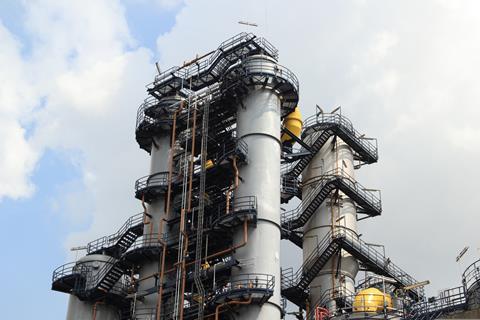
Those pressures are translating directly into changes to plants and processes. Companies are investing in emissions-reduction technologies, modifying processes and formulations, upgrading infrastructure, and adapting sites to meet new environmental and safety requirements.
Leaving risk management behind
One statistic from the survey highlights the challenges that the chemical industry in Europe faces. Sixty percent of companies agree that new sustainability and safety regulations are forcing them to make process changes faster than their internal risk assessments can accommodate. In the past two years, operational changes have contributed to unanticipated downtime, supply chain bottlenecks, and unexpected maintenance costs across much of the sector.
“Many of the largest losses that we see occur not because risks are unknown, but because change outpaces governance,” says Katy Shannon, operations senior vice president, chemical operations manager at FM. “Workforce turnover, new processes, new feedstocks, energy transitions – all potentially introduce complexity faster than organisations can absorb it.”
That puts greater emphasis on the question of when risk teams become involved. FM’s research recommends bringing engineering, regulatory, and risk expertise into projects while design choices are still being made, whether companies are retrofitting legacy facilities, adopting new technologies, or pursuing decarbonisation programmes.
Early involvement gives organisations an opportunity to identify vulnerabilities before decisions become expensive to reverse. Depending on the project, these can include exposures to fire, machinery breakdown, utility failure or business interruption.
For Andrew Bryson, senior vice president, engineering and research at FM, the pressure to anticipate change will only increase. “Regulation is sprinting ahead and those who don’t plan for that will eventually feel it on their balance sheets,” he says.
18% use engineering data to assess how sustainability regulations will affect business continuity and safety.
Closing the insurance gap
Operational transformation can also change the risk profile that an insurance programme was originally designed to cover. Some 43% of chemical industry decision-makers say process changes, retrofits, and new technology implementations have resulted in insurance compliance or coverage gaps in the past two years. Brokers also report difficulty securing sufficient capacity for some chemical risks.
The research suggests that closer dialogue between the business, broker, and insurer can help. Eighty percent of brokers say facilitating direct discussion between clients and underwriters is one of their main strategies for securing stable capacity, while 78% focus on the total cost of risk rather than premium alone.
In chemicals, like many industries, the financial consequences of a major incident can extend beyond physical damage and the insurance claim to lost production, customers, and reputational damage. A total cost of risk approach brings those wider consequences into decisions about insurance and loss prevention.
Shannon describes how the scale of potential loss can be used to make the investment case for prevention.
“It’s about explaining to the client that their current protection scheme – or lack thereof – could present a risk of loss of $500m,” she says, “but with an investment of, say, $1m in physical protection, they can reduce that same loss scenario to $50m.”
That comparison is particularly relevant when 73% of chemical companies identify difficulty proving return on investment as the biggest barrier to securing capital for resilience-focused retrofits. A further 67% cite competition from other projects, while 58% point to short-term cost-cutting or margin protection pressures.
Putting resilience into practice
Chemical companies already recognise the importance of loss prevention. The study found that 95% believe engineering-led loss prevention will be very important to maintaining insurability and competitiveness over the next five years.
Yet organisational barriers continue to stand in the way. More than 90% of respondents say silos between operations, sustainability, finance, and risk or insurance functions hinder integrated risk management, and 90% point to a lack of shared data across business functions.
The gap between ambition and current practice is particularly clear in the use of engineering data. Just 18% of chemical companies say they systematically use it to assess how new sustainability requirements could affect business continuity and safety on site. However, 76% expect to be doing so within three years – demonstrating a clear shift in priorities.
FM recommends developing multi-year resilience priorities at site level, beginning with critical assets and single points of failure across operations and supply chains. Those roadmaps can then guide investment in areas including fire and explosion protection, utilities resilience, natural hazard exposure, and process continuity.
Formal change management is another part of the equation. As organisations introduce new feedstocks, electrify processes, digitise facilities or alter supply chains, the report recommends clear ownership of risk and documented governance around operational changes. Preserving technical knowledge as workforces change is also important if organisations are to avoid losing an understanding of how assets and processes behave.
Insurance relationships can support that process when brokers and insurers are treated as ongoing risk partners, with capacity forming one part of a wider relationship. Sharing long-term investment plans, operational changes, and risk-improvement strategies early gives insurers and engineers greater opportunity to provide targeted input on resilience, risk prioritisation, and loss prevention.
As Bryson puts it: “The art of being an effective risk manager is perhaps to not get distracted by the here and now. You need to be looking ahead to the risks that you will have to manage in the future, and use data and insight to define your investment priorities.”
To read FM’s full Resetting Resilience report, visit www.fm.com/solutions/industries/chemical.













No comments yet