



Risk Type
Operational Risk

AI drives surge in online IP infringement risks
Online intellectual property infringement is increasing as AI makes impersonation, phishing and other attacks faster and easier to scale, leaving businesses under pressure to strengthen monitoring, enforcement and digital governance.

Cannabis farms leave landlords facing six-figure repair bills
Cannabis farms are increasingly being found in shops, offices and other rented commercial premises, leaving landlords exposed to fire, water damage, dangerous electrical alterations and lengthy periods of vacancy, Zurich UK warns.


Case study: How sanctions pressure exposed gaps in Citibank’s controls
A £4.7m fine against Citibank’s London branch exposes how sanctions controls came under strain as alert volumes surged following Russia’s invasion of Ukraine.

Case study: Katoen Natie keeps its ‘feet on the ground’ during M&A, ensuring due diligence trumps racing to completion
Carl Leeman, chief risk officer at Belgium-based logistics, warehousing and engineering company Katoen Natie, explores the risk landscape around M&A activity, sharing insight picked up during his firm’s recent acquisition trail
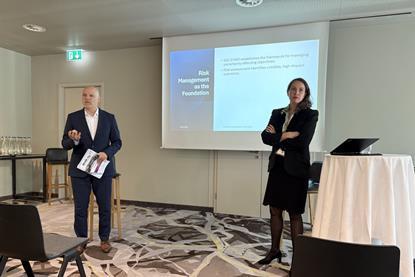
Case study: How Audemars Piguet prepares for the crisis it cannot predict
Audemars Piguet uses risk appetite, continuity planning and predefined crisis triggers to decide when disruption can be managed operationally and when leadership needs to step in.

Sector spotlight: Informal communication ‘scope creep’ exposes CPS sector to slowly changing claims environment
‘Clients [that] are using informal channels can create contractually and legally binding agreements and, if they then default on those agreements, or if they don’t deliver what the customer thought was being promised, then there’s a risk of being exposed to a claim,’ says partner

The engineer: How Gaëtan Lefèvre keeps risk relevant at John Cockerill
After 18 years at one of Europe’s oldest industrial groups, John Cockerill’s Gaëtan Lefèvre knows managing risk only matters if the business truly believes in it. He discusses that battle for relevance and the importance of understanding the inner workings of your company.

Legacy tech: the silent threat to CNI
Jen Modi, regional sales director at Barrier Networks, explores how legacy technology is increasing cyber and operational risk across critical national infrastructure, and what organisations can do to modernise without disrupting essential services.

SR 500: Cyber resilience takes centre stage
Previously a back-office function, resilience in the digital space is now in the spotlight. At an SR:500 roundtable in asssociation with Marsh, risk leaders explored how AI, regulation and culture are highlighting new strategies and demanding board-level attention.

How global programmes can integrate with ERM philosophies leading to better risk management
Expert view: Against the backdrop of global supply chain disruption, geopolitical tension and escalating cyber threats, CROs must embrace centralised decision-making and enterprise risk management strategies. Global programmes can help, says AXA XL’s Ms Shiwei Jin

Greater expectations: Workplace healthcare is becoming a resilience issue, not just a perk
Workplace healthcare is becoming a strategic pressure point, as employees’ rising demands plus costly medical advances are pushing employers to rethink how far benefits should go and what they mean for resilience.

Regulatory convergence puts pressure on GRC leaders to rethink governance
As regulatory frameworks such as NIS2, DORA and the EU AI Act begin to overlap, organisations face mounting pressure to rethink how governance, risk and compliance operates in practice. Riskonnect’s Sherry Dillon explains why traditional compliance approaches are no longer enough.

Watch: Risk that pays - measuring the impact of better decisions
Four risk experts explore how organisations can quantify risk against business objectives, demonstrate the return on investment of risk management and use AI and modern GRC tools to support better strategic decisions, while retaining the human judgement needed to turn data into meaningful insight.
In partnership with 

Why risk managers are turning to parametrics to solve operational challenges
As nat cats grow more severe, insurance gaps are widening - but parametric solutions might hold the key to resilience, says Dianna Nelson, a senior structurer at Swiss Re Corporate Solutions


- Forgotten Password
- Contributors
- Feedback
- Media Pack
- © StrategicRISK 2026
Part of the Insurance and Risk group of
Newsquest Specialist Media
Newsquest Specialist Media



Published by Newsquest Media Group Limited,
registered in England & Wales with number 01676637
at The Echo Building, 18 Albert Road, Bournemouth,
England, BH1 1BZ - a USA Today company
registered in England & Wales with number 01676637
at The Echo Building, 18 Albert Road, Bournemouth,
England, BH1 1BZ - a USA Today company
Site powered by Webvision Cloud